It is said that there are two types of people striving for self sufficiency, diggers and dreamers. People who get stuck in to practical tasks such as digging the land and those who dream of how it will all come together. Of course, to make it work, you need both.
Digging and dreaming, is what we've been doing a lot of recently.
As spring brings a prolonged dry spell, we've realised we have a lot of work to do if we want to have a productive year on our land and we've been concentrating on two fronts;
1. double-digging vegetable plots.
2. preparing our planning application.
I was all up for getting a small plough on the tractor and getting the soil turned over but Janet insisted we (mostly she actually) do it all by hand. This will ensure the job is done properly and avoids unnecessarily compacting the, quite clayey, soil.
So far Janet has planted broad beans, summer cabbage and onions. Alongside have gone in some beneficial flowers; Comfrey, Borage, Nasturtium, dyers Chamomile and some fruit bushes.
In a small corner of the field have gone in three apple trees and a plum.
As spring brings a prolonged dry spell, we've realised we have a lot of work to do if we want to have a productive year on our land and we've been concentrating on two fronts;
1. double-digging vegetable plots.
2. preparing our planning application.
I was all up for getting a small plough on the tractor and getting the soil turned over but Janet insisted we (mostly she actually) do it all by hand. This will ensure the job is done properly and avoids unnecessarily compacting the, quite clayey, soil.
So far Janet has planted broad beans, summer cabbage and onions. Alongside have gone in some beneficial flowers; Comfrey, Borage, Nasturtium, dyers Chamomile and some fruit bushes.
In a small corner of the field have gone in three apple trees and a plum.
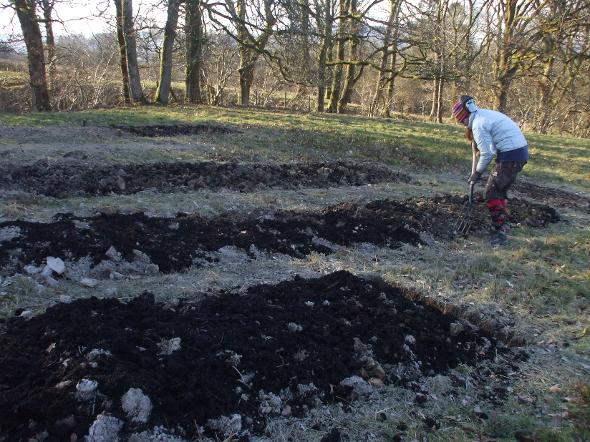
Janet digging in the compost we got from the Council recycling facility. It's a bit rough but at £5 for half a tonne, certainly good for soil conditioning.
The second thing taking up our time is planning.
We are hoping to get permission to live on our land and have for a couple of years been researching how we can get this.
It's very difficult to get permission to live in the open countryside, usually the only route for most people is the agricultural exception.
To do this you have to convince the planning officers that you have a potentially viable agricultural business that requires your almost constant presence on site.
The two main tests is functional - why you have to be there and financial - it will be profitable. There are other tests too which you need to be aware of, time, other buildings, other planning issues etc.
To meet the functional test nearly always hinges on the welfare or safety of animals or people.
The financial test usually requires that the business is in profit within three years and often temporary permission is granted for this time to test the viability.
I say often but it's not at all.
Planners are constantly receiving applications for people wanting to build in the countryside and they can get quite entrenched in resisting development which is why people sometimes build first then wait for the Council to find them. This is not illegal.
If they are discovered living on their land, the Council will probably slap them with an enforcement notice to rectify the breach of planning control. This is a legal requirement but you have 28 days to appeal.
The appeal will be heard by a planning inspector who is an independent professional guided by planning policy and law.
This approach seems to offer the best opportunity for success for people genuinely interested in living a low impact lifestyle on their land as the inspector will be able to visit and see for him/her self what you are doing.
In our opinion, there should be more opportunities for people looking to reduce their ecological impact to live and be self sustaining in the countryside. This may even be essential for a transition to a low carbon society. But the English planning system is stubbornly wedded to the capitalist principle and struggles to understand low impact development. We have heard of one case where a planning officer rejected an application because the home would have little or no re-sale value!
Wales is a little more progressive.
Perhaps it's because of the hippies trying to escape the rat-race, or maybe the Welsh are more intuitive towards the land, or just that a lot of Wales is very rural and not especially prosperous.
Anyway Pembrokeshire has for some years had a specific low impact policy, championed by pioneering projects such as Brithdir Mawr and Lammas.
Now the Welsh Assembly has implemented a similar policy called One Planet Development.
Put simply, if you can prove you are living within one planet's worth of resource, instead of the Welsh average of 2.7 planets, and you need to be in the Countryside to make it work, then you should be given the chance.
There are many, many hoops to jump through and requirements to be met, including annual reporting of progress and a new management plan every five years, but if you are genuinely trying to live a low impact life, then you should be able to meet the requirements. You may also need to be very good at report writing or know someone who is as the two management plans we've seen from people attempting a One Planet Development are both over 125 pages long, although we're not sure if it's entirely necessary, or helpful to be so extensive.
We were planning to build a straw bale house with a bunch of friends, over the four day Easter break and submit a retrospective application (note: retrospective applications are no longer allowed in England).
However, discussions with architects, a group called Calon Cymru, Paul Wimbush of Lammas, considering the use of structural engineers and Approved Building Regs Inspectors and ultimately our own capacity to plan, prepare and execute such a complex operation, left us with a very difficult decision.
Eventually we decided to meet with the Planning Officer in Brecon.
The meeting went well, but the officer concentrated on the Rural Enterprise Dwelling aspect as he had very little experience of the One Planet Development policy, it being so new, the practice guidance has only been out 6 months. But he did indicate that we should apply under either Rural Enterprise or One Planet policies, if we did both then the Council would decide which policy applies.
Afterwards we spent a week wondering how to proceed, eventually we decided that we will apply for permission before building our home and that we will concentrate on the One Planet Development policy as that is our core philosophy, it is a very positive policy and we believe it should be championed.
Now, two weeks later and we are still fine tuning our Management Plan and hope to submit the application soon.
After two years of working towards, we are nervous and strangely reluctant to pull the trigger.
The second thing taking up our time is planning.
We are hoping to get permission to live on our land and have for a couple of years been researching how we can get this.
It's very difficult to get permission to live in the open countryside, usually the only route for most people is the agricultural exception.
To do this you have to convince the planning officers that you have a potentially viable agricultural business that requires your almost constant presence on site.
The two main tests is functional - why you have to be there and financial - it will be profitable. There are other tests too which you need to be aware of, time, other buildings, other planning issues etc.
To meet the functional test nearly always hinges on the welfare or safety of animals or people.
The financial test usually requires that the business is in profit within three years and often temporary permission is granted for this time to test the viability.
I say often but it's not at all.
Planners are constantly receiving applications for people wanting to build in the countryside and they can get quite entrenched in resisting development which is why people sometimes build first then wait for the Council to find them. This is not illegal.
If they are discovered living on their land, the Council will probably slap them with an enforcement notice to rectify the breach of planning control. This is a legal requirement but you have 28 days to appeal.
The appeal will be heard by a planning inspector who is an independent professional guided by planning policy and law.
This approach seems to offer the best opportunity for success for people genuinely interested in living a low impact lifestyle on their land as the inspector will be able to visit and see for him/her self what you are doing.
In our opinion, there should be more opportunities for people looking to reduce their ecological impact to live and be self sustaining in the countryside. This may even be essential for a transition to a low carbon society. But the English planning system is stubbornly wedded to the capitalist principle and struggles to understand low impact development. We have heard of one case where a planning officer rejected an application because the home would have little or no re-sale value!
Wales is a little more progressive.
Perhaps it's because of the hippies trying to escape the rat-race, or maybe the Welsh are more intuitive towards the land, or just that a lot of Wales is very rural and not especially prosperous.
Anyway Pembrokeshire has for some years had a specific low impact policy, championed by pioneering projects such as Brithdir Mawr and Lammas.
Now the Welsh Assembly has implemented a similar policy called One Planet Development.
Put simply, if you can prove you are living within one planet's worth of resource, instead of the Welsh average of 2.7 planets, and you need to be in the Countryside to make it work, then you should be given the chance.
There are many, many hoops to jump through and requirements to be met, including annual reporting of progress and a new management plan every five years, but if you are genuinely trying to live a low impact life, then you should be able to meet the requirements. You may also need to be very good at report writing or know someone who is as the two management plans we've seen from people attempting a One Planet Development are both over 125 pages long, although we're not sure if it's entirely necessary, or helpful to be so extensive.
We were planning to build a straw bale house with a bunch of friends, over the four day Easter break and submit a retrospective application (note: retrospective applications are no longer allowed in England).
However, discussions with architects, a group called Calon Cymru, Paul Wimbush of Lammas, considering the use of structural engineers and Approved Building Regs Inspectors and ultimately our own capacity to plan, prepare and execute such a complex operation, left us with a very difficult decision.
Eventually we decided to meet with the Planning Officer in Brecon.
The meeting went well, but the officer concentrated on the Rural Enterprise Dwelling aspect as he had very little experience of the One Planet Development policy, it being so new, the practice guidance has only been out 6 months. But he did indicate that we should apply under either Rural Enterprise or One Planet policies, if we did both then the Council would decide which policy applies.
Afterwards we spent a week wondering how to proceed, eventually we decided that we will apply for permission before building our home and that we will concentrate on the One Planet Development policy as that is our core philosophy, it is a very positive policy and we believe it should be championed.
Now, two weeks later and we are still fine tuning our Management Plan and hope to submit the application soon.
After two years of working towards, we are nervous and strangely reluctant to pull the trigger.
